

Weekly Market Insights: January 5th, 2026
Stocks trended lower last week amid signs of year-end profit-taking and some sour investor sentiment over the Fed meeting minutes.
The Standard & Poor’s 500 Index fell 1.03 percent, while the Nasdaq Composite Index lost 1.52 percent. The Dow Jones Industrial Average slid 0.67 percent. The MSCI EAFE Index, which tracks developed overseas stock markets, ticked up 0.31 percent.1,2
Santa Rally, Interrupted
Stocks opened lower to start the shortened holiday week with tech shares under pressure. Markets then moved sideways, but came under pressure after minutes from the December Federal Reserve meeting were released. Investors digested the details, which showed members remained divided.3,4
Stocks recovered some ground on the first trading day of 2026. The tech sector was mixed, with AI chip stocks pushing higher, while other areas of technology, especially software companies, declined. Overall, the S&P 500 and Dow Industrials logged gains to kick off the new year, which helped pair losses from earlier in the week.5,6
It remains to be seen whether the “Santa Claus rally”, which ends Monday, January 5, will materialize. The Santa period is the last five trading days of December through the first two trading days of the new year.
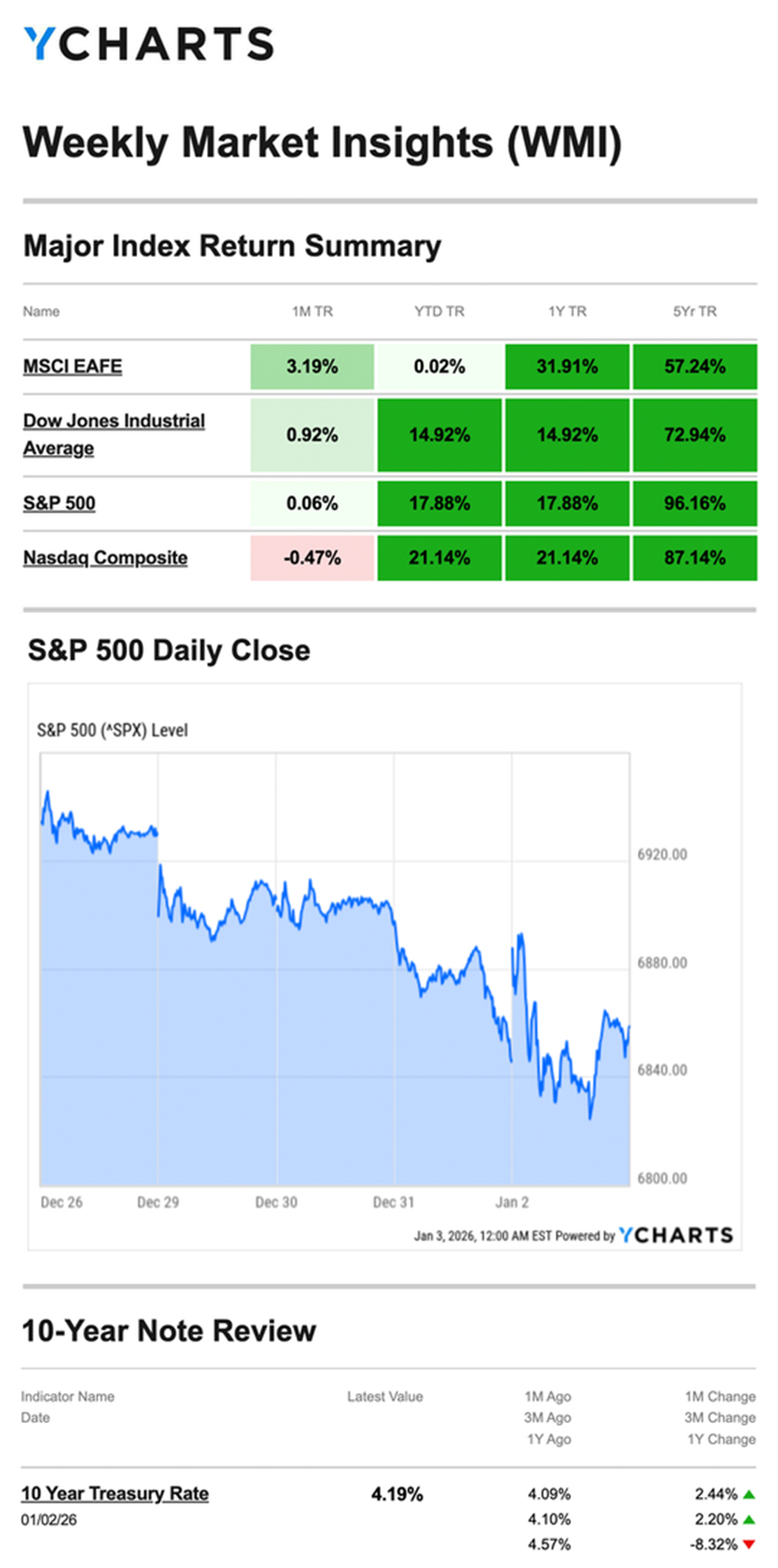
Source: YCharts.com, January 3, 2026. Weekly performance is measured from Friday, December 26, to Friday, January 2. TR = total return for the index, which includes any dividends as well as any other cash distributions during the period. Treasury note yield is expressed in basis points.
Focus on the Fed
There was little economic data last week, leaving investors to focus mostly on the minutes from the Fed’s December meeting. The minutes, released Tuesday, revealed a divided Federal Open Market Committee regarding short-term interest rates. The news unsettled investors a bit, which led to some selling pressure.7
A divided Fed has been a persistent theme during the second half of 2025, and investors will closely watch in 2026 to see whether the Fed’s outlook may change with the appointment of a new Fed Chair.
This Week: Key Economic Data
Monday: Institute of Supply Management (ISM) Manufacturing Index. Auto Sales.
Tuesday: Richmond Fed President Tom Barkin speaks. Purchasing Managers Index (PMI)—Services.
Wednesday: ADP Employment Report. Job Openings* (Nov). Factory Orders* (Oct). Institute of Supply Management (ISM) Services Index. Fed Vice Chair for Supervision Michelle Bowman speaks.
Thursday: Weekly Jobless Claims. Trade Deficit* (Oct). Productivity* (Q3). Consumer Credit (Nov).
Friday: Employment Report. Housing Starts* (Oct). Consumer Sentiment.
* indicates publication of a report delayed by the government shutdown in October and November
Source: Investors Business Daily - Econoday economic calendar; January 2, 2026. The Econoday economic calendar lists upcoming U.S. economic data releases (including key economic indicators), Federal Reserve policy meetings, and speaking engagements of Federal Reserve officials. The content is developed from sources believed to provide accurate information. The forecasts or forward-looking statements are based on assumptions and may not materialize. The forecasts are also subject to revision.
This Week: Companies Reporting Earnings
No major companies are reporting earnings this week.
Source: Zacks, January 2, 2026. Companies mentioned are for informational purposes only. It should not be considered a solicitation for the purchase or sale of the securities. Investing involves risks, and investment decisions should be based on your goals, time horizon, and risk tolerance. The return and principal value of investments will fluctuate as market conditions change. When sold, investments may be worth more or less than their original cost. Companies may reschedule their earnings reports without notice.

"We may encounter many defeats but we must not be defeated."
– Maya Angelou

Recordkeeping Tips for Small Business Owners
As a small business owner, your recordkeeping is of utmost importance. These records show your income, expenses, business transactions, and much more. You can choose any record-keeping system you prefer if you and the IRS have the necessary information.
As a business owner, you will need to keep track of supporting documents such as:
• Purchases
• Sales
• Payroll
• Sales slips
• Paid bills
• Invoices
• Receipts
• Deposit slips
• Canceled checks
• Travel, transportation, entertainment, and gift expenses
• Assets
Keeping your records well-organized will save you time, effort, and money.
This information is not a substitute for individualized tax advice. Please discuss your specific tax issues with a qualified tax professional.
Tip adapted from IRS.gov8

Take Time for Tea
Are you seeking a warm and cozy escape? Look no further than a cup of tea. Chamomile tea even has some potential health benefits!
Here are just a few:
• May lower blood sugar levels in people with diabetes and may help prevent blood sugar spikes
• May reduce inflammation
• May help with sleep and relaxation
• May help treat cold symptoms
Make time for tea!
Tip adapted from Medical News Today9

What starts with P and ends with E and has thousands of letters in it?
Last Week's Riddle: When I lose my jacket, I become larger and louder – but I also weigh a little less. What am I?
Answer: Popcorn.


Tiger's Nest Monastery (Taktsang Palphug Monastery)
Paro, Bhutan
Footnotes And Sources
1 .WSJ.com, January 2, 2026
2. Investing.com, January 2, 2026
3. CNBC.com, December 29, 2025
4. WSJ.com, December 30, 2025
5. CNBC.com, December 31, 2025
6. CNBC.com, January 2, 2026
7. CNBC.com, December 30, 2025
8. IRS.gov, June 24, 2025
9. Medical News Today, August 25, 2025
Investing involves risks, and investment decisions should be based on your own goals, time horizon, and tolerance for risk. The return and principal value of investments will fluctuate as market conditions change. When sold, investments may be worth more or less than their original cost.
The forecasts or forward-looking statements are based on assumptions, may not materialize, and are subject to revision without notice.
The market indexes discussed are unmanaged, and generally, considered representative of their respective markets. Index performance is not indicative of the past performance of a particular investment. Indexes do not incur management fees, costs, and expenses. Individuals cannot directly invest in unmanaged indexes. Past performance does not guarantee future results.
The Dow Jones Industrial Average is an unmanaged index that is generally considered representative of large-capitalization companies on the U.S. stock market. The Nasdaq Composite is an index of the common stocks and similar securities listed on the Nasdaq stock market and considered a broad indicator of the performance of stocks of technology and growth companies. The MSCI EAFE Index was created by Morgan Stanley Capital International (MSCI) and serves as a benchmark of the performance of major international equity markets, as represented by 21 major MSCI indexes from Europe, Australia, and Southeast Asia. The S&P 500 Composite Index is an unmanaged group of securities that are considered to be representative of the stock market in general.
U.S. Treasury Notes are guaranteed by the federal government as to the timely payment of principal and interest. However, if you sell a Treasury Note prior to maturity, it may be worth more or less than the original price paid. Fixed income investments are subject to various risks including changes in interest rates, credit quality, inflation risk, market valuations, prepayments, corporate events, tax ramifications and other factors.
International investments carry additional risks, which include differences in financial reporting standards, currency exchange rates, political risks unique to a specific country, foreign taxes and regulations, and the potential for illiquid markets. These factors may result in greater share price volatility.
Please consult your financial professional for additional information.
This content is developed from sources believed to be providing accurate information. The information in this material is not intended as tax or legal advice. Please consult legal or tax professionals for specific information regarding your individual situation. This material was developed and produced by FMG Suite to provide information on a topic that may be of interest. FMG is not affiliated with the named representative, financial professional, Registered Investment Advisor, Broker-Dealer, nor state- or SEC-registered investment advisory firm. The opinions expressed and material provided are for general information, and they should not be considered a solicitation for the purchase or sale of any security.
Copyright 2026 FMG Suite.
Cooper Capital Advisors, LLC dba Cooper Capital Group is a Registered Investment Adviser. The information provided within this website and the materials posted are for informational purposes only. Some content posted within this website is sourced from a third party, which is also for informational purposes only. Advisory services are only offered to clients or prospective clients where Cooper Capital Advisors, LLC dba Cooper Capital Group and its representatives are properly licensed or exempt from licensure. Past performance is no guarantee of future returns. Investing involves risk and possible loss of principal capital. No advice may be rendered by Cooper Capital Advisors, LLC dba Cooper Capital Group unless a client service agreement is in place.